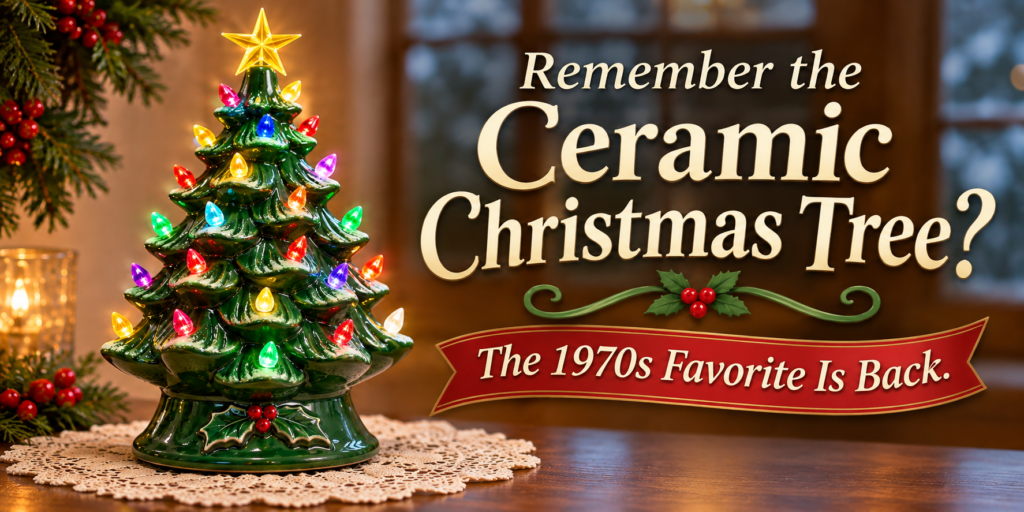
Remember the ceramic Christmas tree? The little green one with the shiny branches, colored lights, and a star perched on top? It might have stood on your grandmother’s television cabinet, on a side table beside the sofa, or in the front window where everyone passing by could see it.
For many families, switching on that tree was as much a part of Christmas as hanging stockings or bringing out the good dishes. And now the ceramic Christmas tree is finding its way back into homes, including those of people too young to remember its first great popularity.
The Christmas Tree That Came From a Ceramics Class
Although most people associate ceramic Christmas trees with the 1970s, their story began earlier. Individual artists made them by the 1940s. In 1958, the Atlantic Mold Company copyrighted its A-64 Christmas tree mold, one of the designs that helped turn the decoration into a familiar holiday project.
During the 1960s and 1970s, ceramics studios offered classes where people could paint and glaze their own trees. A hobbyist might choose deep evergreen, snowy white, or a finish with a pearly sheen. The finished piece was fired in a kiln, fitted with tiny colored bulbs, and brought home to be displayed each December.
Many of those trees were handmade gifts. A mother made one for her daughter. A grandmother painted one for the family. Some carried initials or dates scratched into the clay. Others had no signature at all, but everyone knew who had made them.
Early versions sometimes had individually illuminated miniature bulbs. Later designs commonly used a single light inside the hollow tree, shining through colorful translucent plastic pegs. It was a clever arrangement: one bulb could make an entire tabletop tree glow.
Why We Remember Them So Well
A ceramic tree did not compete with the big Christmas tree in the living room. It had its own place. It could brighten a dark hallway, a bedroom dresser, or the kitchen counter while someone prepared Christmas dinner.
Unlike ornaments that changed from year to year, the ceramic tree was often exactly the same every Christmas. The same glossy branches. The same red, blue, green, and yellow lights. Sometimes the same missing peg that nobody ever got around to replacing.
And because so many were made by hand, they carried a family history. A small chip or an uneven patch of glaze might tell you more about the person who made it than a perfectly finished new decoration ever could.
How the Ceramic Christmas Tree Made Its Comeback
As home ceramics classes declined and inexpensive factory-made decorations became more common, the trees gradually disappeared from many store shelves. But they did not disappear from family cupboards and attics.
Years later, people began searching for the trees they remembered from childhood. Some wanted to replace a broken heirloom. Others had inherited one and discovered that it suited their Christmas decorations perfectly. Antique shops, online marketplaces, and modern manufacturers helped introduce the familiar design to a new generation.
Today you can find classic green trees with multicolored lights, white trees with a softer glow, and updated versions in pink, silver, and other finishes. The shape is familiar even when the colors change.
Where to Find a Ceramic Christmas Tree Today
If your family’s tree is still tucked away in a box, it is worth bringing it out and checking its condition. If not, modern reproductions offer the same cheerful tabletop look without having to hunt down a vintage example.
Shopping note: The following Amazon search links are affiliate links. We may earn a commission from qualifying purchases at no additional cost to you.
The 15-inch Best Choice Products pre-lit ceramic Christmas tree is a convenient tabletop size for a mantel, sideboard, or entry table. Browse Best Choice Products ceramic Christmas trees on Amazon.
For a larger display, the 18-inch Mr. Christmas nostalgic ceramic tree offers the traditional shape with modern lighting. Browse Mr. Christmas 18-inch ceramic trees on Amazon.
These links open Amazon search results rather than a particular listing, so you can compare the available colors, dimensions, and current offers before choosing.
If You Have an Original, Take a Closer Look
Before you plug in an older tree, examine its cord, socket, and base. If the wiring is damaged or brittle, have it replaced by someone qualified rather than using it as it is. Missing plastic light pegs can often be replaced, too.
Look underneath for a mold maker’s name, such as Atlantic, Holland Mold, or Arnel’s. But do not assume that a stamped year tells you when your particular tree was made. It may identify the copyright date of the mold, which could have been used for many years afterward.
For more on the history of these decorations, see the American Ceramic Society’s account of ceramic Christmas trees and Our State’s story of their return.
A Small Tree With a Long History
There are plenty of new Christmas decorations to choose from every year. Yet people keep returning to this little tree, with its old-fashioned lights and glazed ceramic branches.
Perhaps yours belonged to someone in the family. Perhaps you made one in a ceramics class years ago. Or perhaps this Christmas will be the first time you bring one home.
Whatever its history, it asks for very little: a safe place to stand, a light to shine through its branches, and a place among the Christmas decorations that come out year after year.
As an Amazon Associate I earn from qualifying purchases.


